A creative copywriter crafts compelling, persuasive content that drives action and builds brand identity. From advertising campaigns to ecommerce product pages, creative copywriters blend language mastery, audience empathy, and strategic thinking to produce copy that converts—across every platform and format.
Words have always moved people. They’ve started revolutions, built empires, and sold millions of products. Behind every campaign that stopped you mid-scroll, every tagline you still remember years later, and every product description that made you hit “Add to Cart”—there’s a creative copywriter at work.
As digital channels multiply and consumer attention shrinks, the demand for skilled copywriting has never been higher. Businesses compete not just on product quality, but on their ability to communicate value clearly and memorably. A creative copywriter sits at the center of that challenge.
This post breaks down everything you need to know about the creative copywriter role: what skills define it, how the creative process works, which tools support modern copywriters, and how artificial intelligence is reshaping—but not replacing—the profession. Whether you’re considering a career in copywriting or looking to hire one, this guide covers it all.
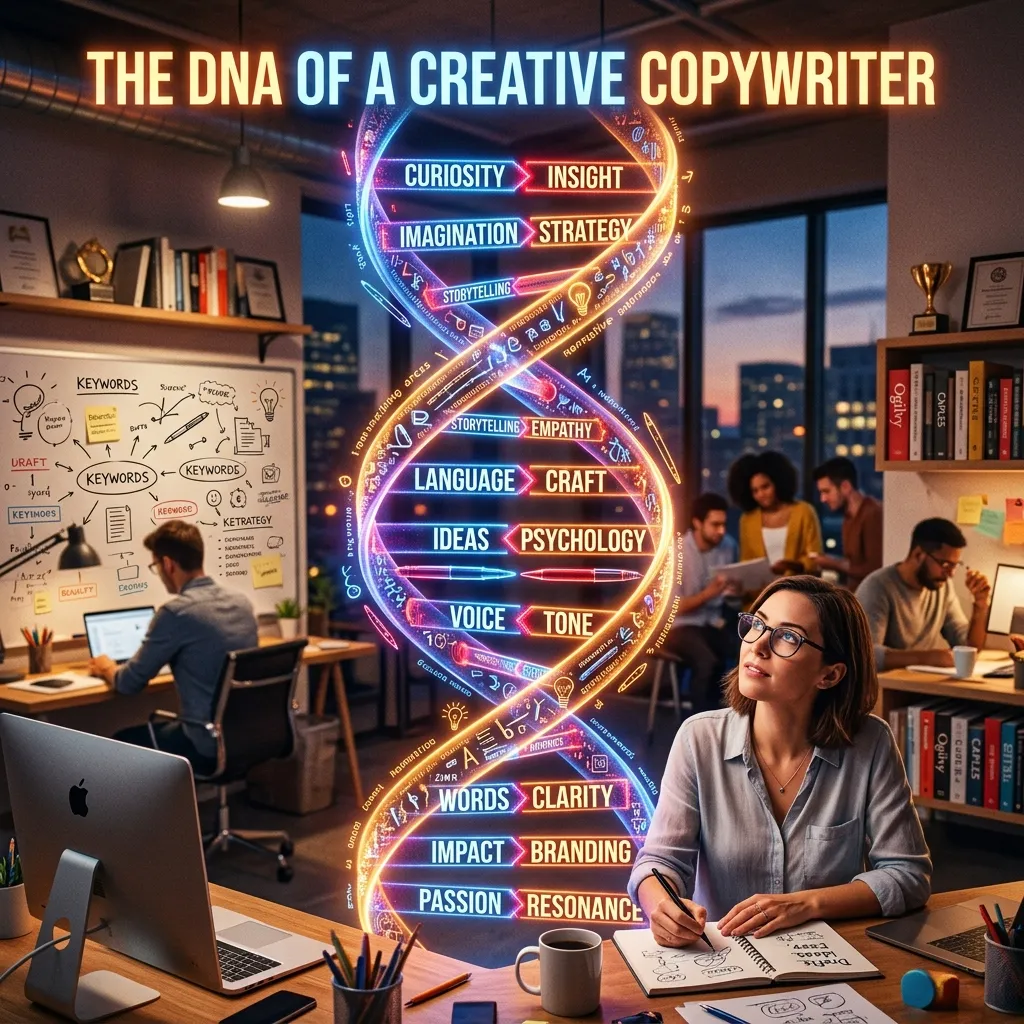
The DNA of a Creative Copywriter
What traits define a great creative copywriter?
Not everyone who can write is a copywriter. And not every copywriter is creative. The best creative copywriters combine a specific set of traits that, together, produce copy that resonates and converts.
Imagination and Originality
Creative copywriters don’t recycle ideas—they generate them. Strong creative instinct allows a copywriter to approach a familiar product from an unexpected angle, finding the story or hook that makes an audience lean in. Originality isn’t just about being different; it’s about being relevant and memorable.
Empathy and Audience Understanding
Effective copy starts with understanding who you’re writing for. A skilled creative copywriter doesn’t just know their audience’s demographics—they understand their fears, desires, frustrations, and aspirations. That empathy shapes every word choice and structural decision.
Mastery of Language
Grammar, syntax, rhythm, and tone are the tools of the trade. Creative copywriters know when to break grammatical rules for effect and when to follow them precisely. They adjust tone fluidly—authoritative for a legal firm, playful for a snack brand, urgent for a flash sale.
Persuasion and Calls to Action
Copy without persuasion is just writing. Creative copywriters understand psychological principles like social proof, scarcity, and reciprocity. They craft calls to action that feel natural, not pushy, and guide readers toward a specific behavior.
Adaptability Across Platforms
A tweet and a billboard require very different approaches. Creative copywriters adapt to the constraints and conventions of each platform—from 280-character social posts to long-form landing pages—without losing their brand voice or strategic intent.
Roles and Responsibilities: Types of Creative Copywriters
What are the different types of creative copywriter roles?
The creative copywriter title covers a wide range of specializations. Each type requires a slightly different skill set and mindset.
Advertising Copywriter
The advertising copywriter is perhaps the most iconic version of the role. These professionals craft the campaigns you see on television, hear on radio, and encounter across digital media. Their work is concept-driven—often collaborating with art directors to create unified visual-verbal ideas. A great advertising copywriter produces work that lives beyond a single campaign cycle, creating cultural touchpoints that endure.
Sales Copywriter
A sales copywriter focuses on one thing above all else: driving conversions. Their copy appears in sales emails, landing pages, direct mail, and paid ads. Sales copywriters are fluent in persuasion frameworks like AIDA (Attention, Interest, Desire, Action) and PAS (Problem, Agitate, Solution). Their success is measurable—conversion rates don’t lie.
Ecommerce Copywriter
The ecommerce copywriter specializes in product descriptions, category pages, and the micro-copy that guides customers through an online store. Their work directly influences purchasing decisions. A well-written product description doesn’t just list features—it translates those features into tangible benefits that answer the customer’s unspoken question: “What’s in it for me?”
Content Copywriter
Content copywriters produce blog posts, articles, whitepapers, and newsletters. Their primary goal is to inform, educate, or entertain—building audience trust over time rather than driving immediate action. SEO knowledge is often central to this role.
Brand Storyteller
Some creative copywriters specialize in narrative: defining a brand’s voice, crafting its origin story, and ensuring every piece of communication feels cohesive. Brand storytellers work closely with marketing strategy teams to build the emotional architecture of a brand.
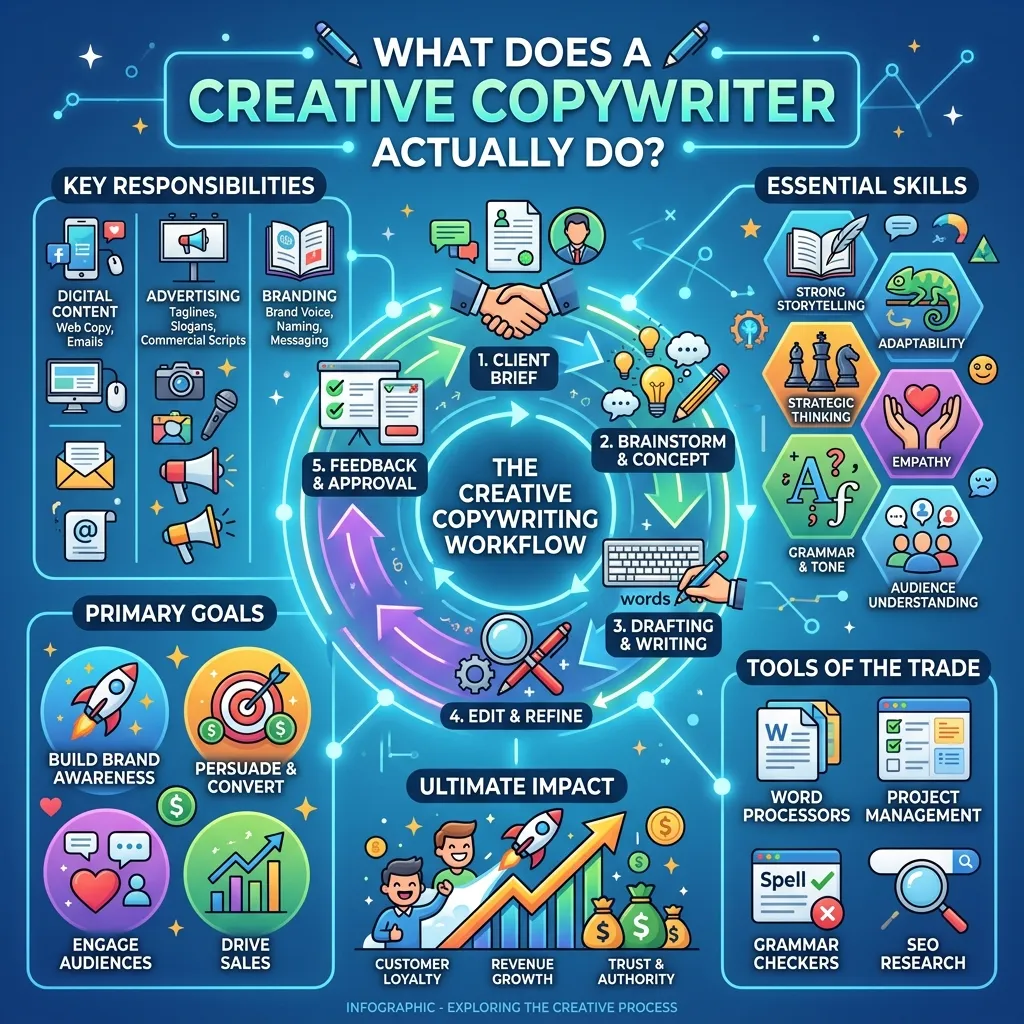
The Creative Process: From Brief to Brilliance

How does a creative copywriter develop copy from start to finish?
Great copy rarely appears fully formed. It emerges through a structured—if often messy—creative process.
Understanding the Brief and Client Objectives
Every project begins with a brief. Creative copywriters interrogate it thoroughly: Who is the audience? What action should the copy drive? What tone fits the brand? What are the non-negotiables? A vague brief produces vague copy. Skilled copywriters push back, ask questions, and clarify before writing a single word.
Research and Audience Analysis
Research separates good creative copywriters from great ones. This phase involves studying the target audience, analyzing competitors, reviewing customer reviews (a goldmine for authentic language), and understanding the product or service in depth. The deeper the research, the more specific and compelling the copy.
Brainstorming and Idea Generation
Before drafting, creative copywriters generate multiple angles, hooks, and concepts. Many use techniques like mind mapping, “what if” questioning, or simply free-writing to unlock unexpected ideas. The goal isn’t to find one good idea immediately—it’s to explore enough territory that the best idea reveals itself.
Drafting and Refining
The first draft is about momentum, not perfection. Experienced creative copywriters write freely, knowing refinement comes later. Structure, clarity, and rhythm are shaped in subsequent drafts. This iterative approach allows the best ideas to surface without the paralysis of premature self-editing.
Editing and Proofreading
Editing is where copy becomes copy. Creative copywriters cut ruthlessly—eliminating redundancy, sharpening every sentence, and ensuring every word earns its place. Proofreading catches the technical errors that undermine credibility.
Collaboration and Feedback
Copy rarely ships without input from designers, strategists, clients, or account managers. Strong creative copywriters welcome feedback and distinguish between subjective preference and strategic insight. Collaboration often improves the final product significantly.
Tools and Technologies for the Modern Creative Copywriter
What tools do creative copywriters use today?
The modern creative copywriter works within a rich ecosystem of tools that accelerate research, improve quality, and streamline collaboration.
AI Writing Assistants
AI writing tools like Jasper, ChatGPT, and Grammarly have become standard in many copywriters’ workflows. These tools help with brainstorming, overcoming writer’s block, and refining drafts. They don’t replace creative judgment—but they do reduce the time spent on mechanical tasks, freeing copywriters to focus on strategy and craft.
SEO Tools for Visibility
Tools like Ahrefs, SEMrush, and Surfer SEO help copywriters identify high-value keywords, analyze search intent, and optimize content for organic visibility. For content and ecommerce copywriters especially, SEO fluency is non-negotiable.
Project Management Software
Platforms like Asana, Trello, and Notion help creative copywriters manage multiple projects, track deadlines, and collaborate with clients and teams. Organized workflow management is what separates freelance professionals from hobbyists.
Design Tools for Visual Integration
Copy and design are inseparable in most modern formats. Familiarity with tools like Figma, Canva, or Adobe XD helps creative copywriters understand how their words will appear visually—and write accordingly.
Measuring Success: Metrics and KPIs
How do you measure the effectiveness of creative copywriting?
Creative work can feel subjective, but its outcomes are measurable.
Conversion Rates remain the most direct indicator of copy effectiveness—especially for sales copywriters and ecommerce copywriters. If copy changes, and conversions change, the copy made a difference.
Engagement Metrics—clicks, shares, comments, and time-on-page—reflect how well content copy resonates with audiences. High engagement signals that the copy is relevant, interesting, and shareable.
Brand Recognition and Sentiment are longer-term indicators. Tracking brand mentions, net promoter scores, and sentiment analysis reveals whether copy is building the right associations over time.
ROI of Copy ties creative output directly to revenue. For advertising copywriters and sales copywriters, this might mean measuring revenue generated per email campaign or cost-per-acquisition from a paid ad.
The Future of Creative Copywriting in an AI-Driven World
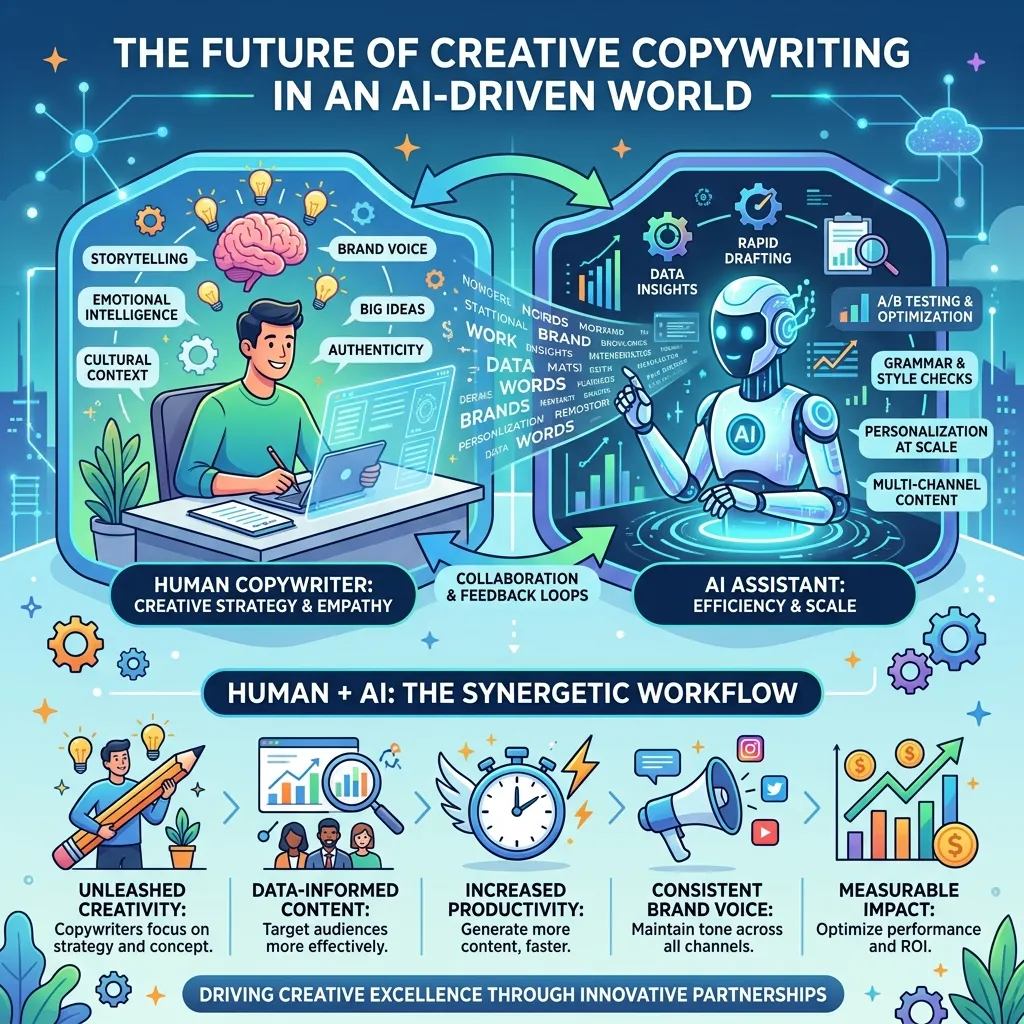
Will AI replace creative copywriters?
This question surfaces constantly—and the honest answer is nuanced.
AI tools are becoming increasingly capable at generating grammatically correct, contextually relevant text at scale. For templated, low-stakes content, AI can already handle the volume. But creative copywriting has never been about volume. It’s been about insight, originality, and emotional resonance—qualities that AI simulates but doesn’t genuinely possess.
AI as a Co-Pilot, Not a Replacement
The most effective creative copywriters today treat AI as a collaborator. They use it to accelerate research, generate initial drafts, and explore multiple directions quickly. But the strategic thinking, the conceptual leap, the unexpected angle that makes a campaign unforgettable—that still comes from a human mind.
The Human Element: Creativity, Emotion, and Ethics
Audiences respond to copy that feels human. They detect inauthenticity quickly. The creative copywriter’s ability to draw on lived experience, cultural nuance, and genuine empathy gives human-written copy a texture that AI-generated content currently lacks. Ethical considerations—around representation, sensitivity, and truthfulness—also require human judgment.
Continuous Learning and Skill Development
The creative copywriters who will thrive in the next decade are those who invest in developing both their creative instincts and their technical fluency. Understanding AI tools, SEO principles, data analytics, and emerging platform conventions will be just as important as writing ability. The profession is evolving—and so must its practitioners.
Conclusion
The role of the creative copywriter sits at the intersection of art and strategy. These professionals shape how brands communicate, how products are perceived, and how audiences are moved to act. From the advertising copywriter building a campaign that lodges in cultural memory, to the ecommerce copywriter whose product description tips a browser into a buyer—creative copywriting is one of the most impactful disciplines in modern marketing.
AI will continue to change the tools available, but it won’t change the fundamental value of a human who can think creatively, write persuasively, and connect authentically with an audience. If anything, that skill becomes more valuable as automated content floods every channel.
Invest in the craft. Stay curious. Keep writing.
Frequently Asked Questions
What is a creative copywriter?
A creative copywriter is a professional who writes persuasive, engaging content designed to drive specific actions—such as purchases, sign-ups, or brand engagement. Creative copywriters work across formats including advertisements, websites, emails, social media, and product descriptions.
How is a creative copywriter different from a content writer?
A content writer primarily focuses on informing or educating an audience—blog posts, guides, and articles. A creative copywriter focuses on persuasion and action, crafting copy that drives conversions, builds brand identity, or sells products. In practice, many professionals blend both skill sets.
What skills are essential for a creative copywriter?
Core skills include strong command of language, audience empathy, persuasive writing, adaptability across platforms, and research ability. Increasingly, SEO knowledge, data literacy, and familiarity with AI writing tools are also important.
How can I become a creative copywriter?
Start by studying great copy—analyze ads, landing pages, and email campaigns you admire. Build a portfolio with speculative or freelance work. Study copywriting frameworks like AIDA and PAS. Consider formal training through copywriting courses or a related degree in communications or marketing.
What is the average salary of a creative copywriter?
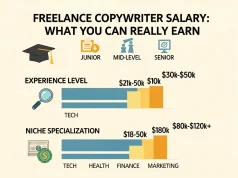
According to the U.S. Bureau of Labor Statistics, writers and authors earn a median annual salary of around $73,000. Experienced creative copywriters at agencies or in senior in-house roles often earn significantly more, while top-tier freelancers can exceed six figures.
How does AI impact the role of a creative copywriter?
AI tools help creative copywriters work faster by assisting with research, drafting, and editing. However, AI doesn’t replace the strategic and creative judgment that defines strong copywriting. The best creative copywriters use AI as a productivity tool, not a substitute for original thinking.
What types of industries hire creative copywriters?
Creative copywriters work across virtually every industry—advertising agencies, ecommerce brands, technology companies, financial services, healthcare, entertainment, nonprofits, and more. Any organization that communicates with an audience has a need for skilled copywriting.
How do creative copywriters ensure their work is original?
Creative copywriters conduct thorough research, develop unique angles based on audience insight, and run copy through plagiarism-checking tools when needed. Originality also comes from developing a distinct creative voice and constantly exposing oneself to diverse creative influences.
What is the importance of an advertising copywriter?
An advertising copywriter creates the campaigns that shape brand perception at scale. Their work—across TV, radio, digital, and out-of-home advertising—builds the emotional associations that influence consumer behavior over time. A single memorable campaign can define a brand for decades.
How does an ecommerce copywriter contribute to sales?
An ecommerce copywriter directly influences purchasing decisions through product descriptions, category page copy, and on-site messaging. Well-crafted ecommerce copy reduces friction, answers buyer questions, and creates the confidence needed to convert browsers into buyers.
What are some common challenges faced by creative copywriters?
Common challenges include managing multiple client briefs simultaneously, writing to tight deadlines, maintaining creative freshness across repetitive formats, navigating client feedback, and staying current with evolving SEO and platform requirements.
How can a creative copywriter improve their craft?
Read widely—not just copywriting, but fiction, journalism, and nonfiction. Study campaigns that performed well and try to understand why. Seek feedback actively, practice writing every day, and stay informed about developments in digital marketing, AI tools, and consumer behavior.