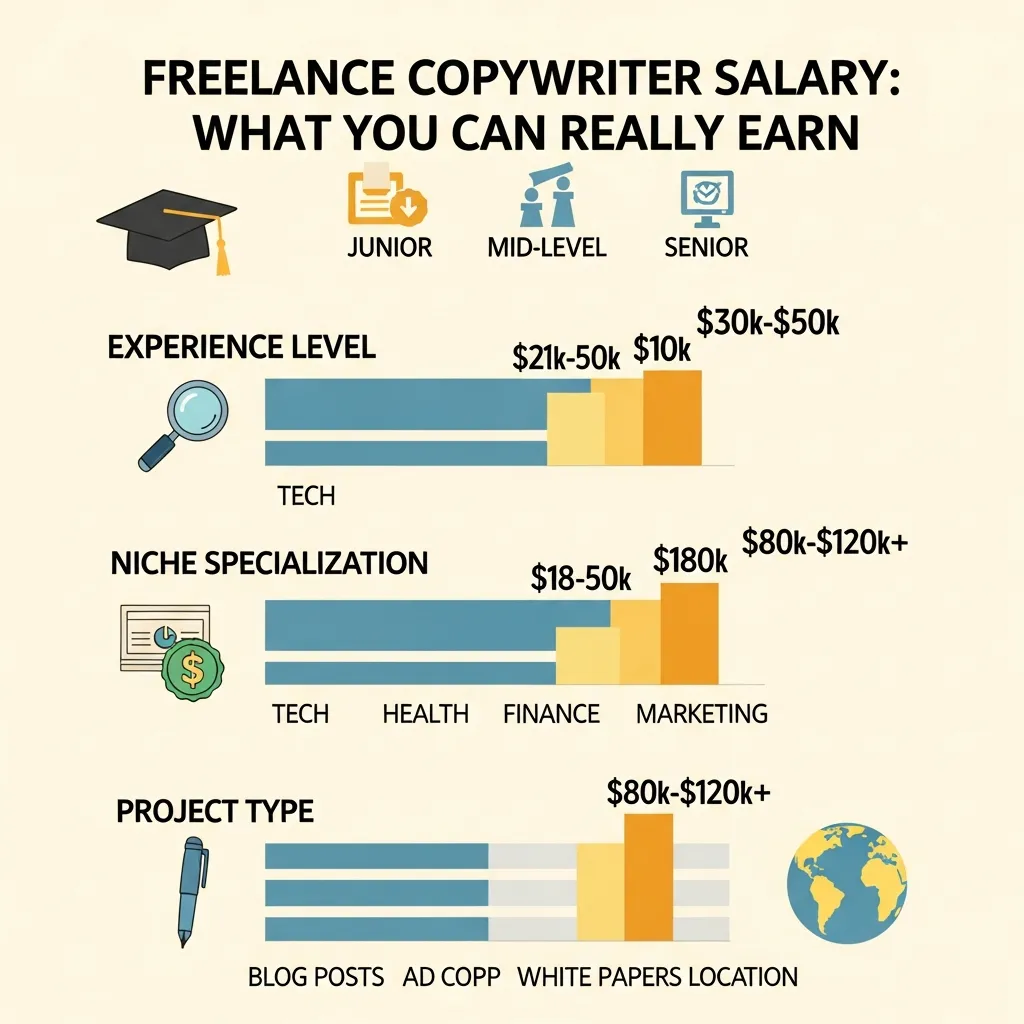
Freelance copywriter salary ranges from $30,000/year for beginners to over $150,000/year for seasoned specialists. Earnings depend on experience, niche, location, client type, and pricing strategy. This post breaks down real salary ranges, the factors that move the needle, and actionable steps to earn more.
The appeal of freelancing is real—set your own hours, choose your clients, work from anywhere. But before you hand in your resignation, the big question looms: can you actually make a living as a freelance copywriter?
Copywriting—the craft of writing persuasive content that drives action—is one of the most in-demand skills in the digital economy. Businesses of every size need compelling website copy, email sequences, ad campaigns, product descriptions, and more. And the demand keeps growing. According to the U.S. Bureau of Labor Statistics, employment for writers and authors is projected to grow 4% through 2032, with content and copywriting roles driving much of that demand.
Still, “copywriting is in demand” doesn’t pay your rent. What you actually need is a clear-eyed picture of what freelance copywriters earn—at every stage of their career—and what separates those who struggle to hit $40,000 a year from those billing $150,000 or more.
That’s exactly what this guide covers. Whether you’re just exploring freelance copywriting jobs for the first time or you’re an experienced writer looking to push your income higher, you’ll leave with a solid understanding of real salary ranges, the key factors that drive earnings, and practical strategies to maximize your freelance copywriter salary.
What Does a Freelance Copywriter Actually Do?

A freelance copywriter creates written content designed to persuade, inform, or motivate an audience. Unlike staff writers on a payroll, freelance copywriters work independently—often juggling multiple clients, projects, and deadlines at once.
The copywriting field spans several distinct disciplines:
- Marketing copywriting: Sales pages, email campaigns, social media ads, landing pages
- SEO copywriting: Blog posts, web content, and articles optimized for search engines
- Technical copywriting: Manuals, white papers, product documentation—especially in tech, engineering, or science
- UX copywriting: Microcopy, interface text, onboarding flows
- Direct response copywriting: Long-form sales letters and conversion-focused ads
Each type of copywriting carries a different earning ceiling. A technical copywriter, for example, commands significantly higher rates than a general blog writer—largely because technical writing requires specialized knowledge that fewer writers possess.
Demand for skilled copywriters continues to rise alongside digital advertising spend and content marketing budgets. HubSpot’s 2023 State of Marketing report found that content marketing remains one of the top three marketing investments for businesses globally, which means ongoing demand for the people who write that content.
Key Factors That Influence Freelance Copywriter Salary
No two freelance copywriters earn the same. Here’s what actually moves the number up or down.
How Does Experience Level Affect Copywriter Earnings?
Experience is the single biggest driver of freelance copywriter salary. Entry-level copywriters are learning the craft and building a client base, which means lower rates and more time spent on unpaid tasks like proposals and revisions. Mid-level and senior copywriters bring proven results—which lets them charge significantly more.
Does Specialization Lead to a Higher Freelance Copywriter Salary?
Absolutely. Generalists are everywhere; specialists are scarce. A technical copywriter working in cybersecurity, pharmaceuticals, or SaaS can command two to three times the rate of a generalist writing lifestyle blog posts. High-paying niches include:
- Technology and SaaS
- Finance and fintech
- Medical and healthcare
- Legal services
- Industrial and engineering
Specialization isn’t just about subject knowledge—it signals credibility, which justifies premium pricing.
Does Location Still Matter for Freelance Copywriters?
Remote work has diluted geographic boundaries, but location still matters. Copywriters in high-cost cities like New York, San Francisco, or London typically charge more—and clients in those markets expect to pay more. If you’re working internationally, currency differences and client expectations also play a role.
How Does Client Type Affect Pay?
Solopreneurs and small businesses often have tight budgets. Agencies pay more, but may apply rate pressure through volume. Large corporations and enterprise clients pay the most—and often pay faster. Building relationships with higher-tier clients is one of the most direct paths to a higher freelance copywriter salary.
What Pricing Model Pays the Most?
Freelance copywriters typically price their work in one of four ways:
- Hourly rates: $25–$150+/hour depending on experience
- Per-word rates: $0.05–$1.00+ per word (rare for experienced writers)
- Project-based fees: Flat rates per deliverable (most common)
- Retainer agreements: Monthly fees for ongoing work (most stable)
Project-based and retainer pricing tend to deliver the highest effective hourly rate, because experienced copywriters can complete work quickly without penalizing their income the way hourly billing does.
Why Do Portfolio Quality and Social Proof Matter?
Clients hire based on evidence. A portfolio with measurable results—”this email sequence increased click-through rates by 34%”—is far more powerful than a collection of polished samples. Testimonials from recognizable brands amplify trust. The stronger your social proof, the less you negotiate on price.
Average Freelance Copywriter Salary: What the Numbers Look Like
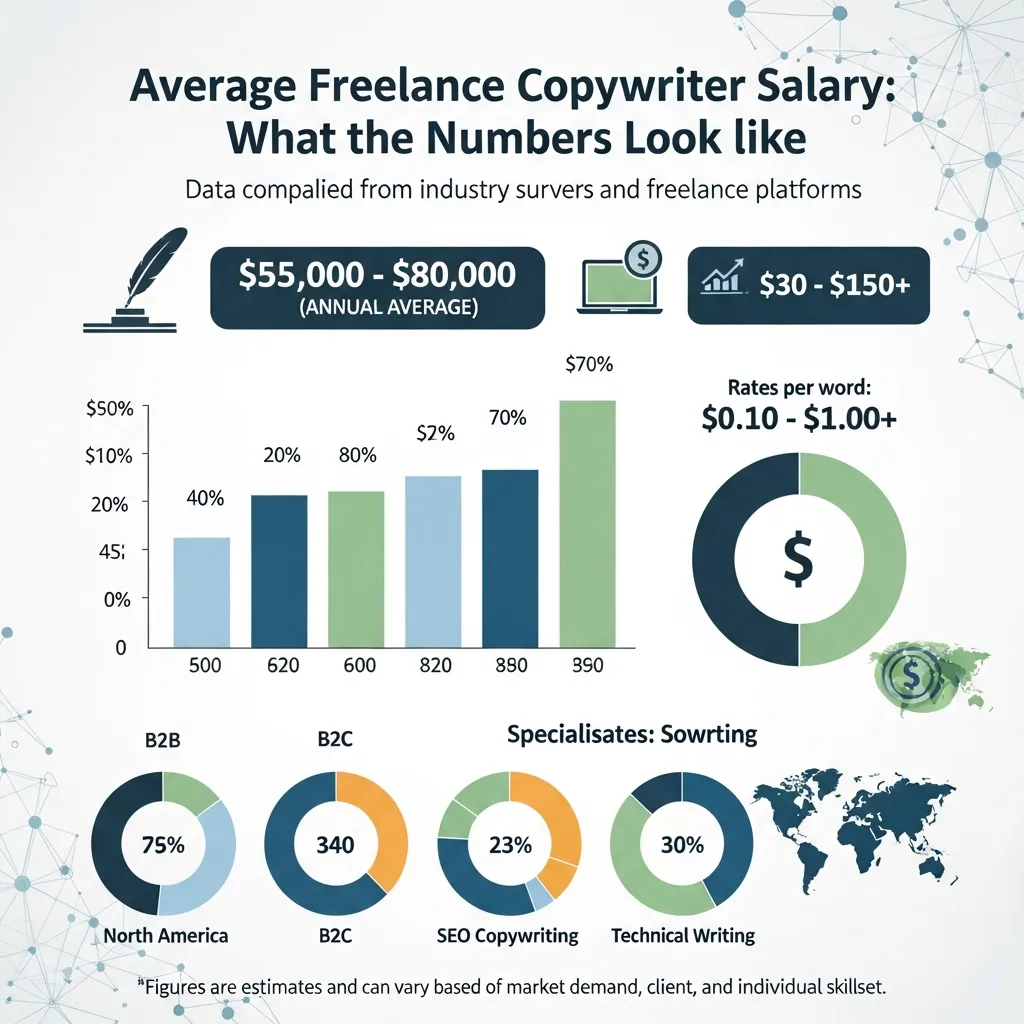
Earnings vary widely, but here’s a realistic breakdown by experience level.
Entry-Level Freelance Copywriter Salary
New copywriters typically earn between $20,000 and $45,000 per year, depending on how aggressively they pursue clients. Early on, many start with freelance jobs for beginners on platforms like Upwork, Fiverr, or ProBlogger to build their portfolio and gather testimonials. Rates in this range hover around $25–$50 per hour, or $100–$500 per project.
Mid-Career Freelance Copywriter Salary
With two to five years of experience and a focused niche, copywriters typically earn between $60,000 and $100,000 per year. At this stage, most work on project-based or retainer agreements, with hourly equivalent rates of $75–$125.
Senior and Expert Freelance Copywriter Salary
Top-tier freelance copywriters—those with a strong niche, proven ROI for clients, and established reputations—earn $100,000 to $200,000+ per year. Technical copywriters and direct response specialists frequently sit at the high end of this range. Some of the most in-demand copywriters charge $5,000–$25,000 per project.
Rate Comparison by Project Type
|
Project Type |
Typical Rate Range |
|---|---|
|
Blog post (1,000 words) |
$100–$800 |
|
Website copy (5 pages) |
$1,500–$5,000 |
|
Email sequence (5 emails) |
$500–$3,000 |
|
White paper |
$2,000–$10,000 |
|
Sales page |
$1,500–$15,000+ |
Where to Find Freelance Copywriting Jobs
Platforms worth exploring include:
- Upwork – Large marketplace, good for beginners
- LinkedIn – Strongest for B2B clients
- ProBlogger Job Board – Content and copywriting-specific
- ClearVoice / Contently – Curated platforms for experienced writers
- Direct outreach – Cold email campaigns to target clients remain one of the highest-ROI acquisition methods for established copywriters
How to Maximize Your Freelance Copywriter Salary
Build a Profitable Niche
The fastest way to increase your freelance copywriter salary is to stop being a generalist. Pick an industry you understand well—or can learn quickly—and position yourself as the go-to copywriter in that space. Clients in specialized fields pay more for writers who already speak their language.
Shift to Value-Based Pricing
Hourly billing caps your income. Value-based pricing ties your fee to the outcome you create, not the time you spend. If an email sequence generates $50,000 in revenue for a client, charging $3,000 for it is entirely defensible. This mindset shift alone can dramatically move your annual freelance copywriter salary.
Invest in Upskilling
SEO, conversion rate optimization, email marketing strategy, and AI-assisted writing workflows are all skills that expand your value to clients. Copywriters who understand the broader marketing context—not just the writing—consistently out-earn those who don’t.
Land Retainer Clients
Retainer agreements are the closest thing freelancing has to a salary. A client paying $2,000–$5,000 per month for ongoing work creates predictable income that lets you plan, invest, and grow. Aim to fill 50–70% of your capacity with retainer clients before actively pursuing new one-off projects.
Sharpen Client Acquisition
The most successful freelance copywriters treat marketing themselves as seriously as they treat client work. A targeted LinkedIn presence, a conversion-optimized personal website, and a consistent outreach strategy keep the pipeline full—which gives you the leverage to say no to low-paying work.
Optimize for Efficiency
Time is your most finite resource. Systems for client onboarding, project scoping, invoicing, and revision management free up hours that go directly toward billable work. Copywriters who optimize their workflows earn more without working more.
For those just starting out, consistently pursuing freelance jobs for beginners—even at lower rates—builds the portfolio and client relationships that unlock higher-paying opportunities later. Strategic short-term trade-offs often drive long-term income growth.
The Freelance Copywriter Lifestyle: Beyond the Numbers
Salary figures tell part of the story. The freelance copywriter lifestyle adds important context.
The upside is real. Flexibility, autonomy, and the ability to build income streams across multiple clients are genuine advantages over traditional employment. Many freelance copywriters report higher job satisfaction than their salaried counterparts, particularly as their careers mature.
The challenges are equally real. Income volatility, self-employment taxes, the unpaid time spent on admin and business development, and the absence of employer-sponsored benefits all factor into the true economic picture. Experienced freelancers typically build emergency funds covering three to six months of expenses to buffer lean periods.
Work-life balance often improves with experience. Early-career freelancers frequently overwork trying to build momentum. As systems improve and higher-paying clients replace lower-paying ones, the same income—or more—becomes achievable in fewer hours.
Building a Long-Term Freelance Copywriting Career

Freelance copywriter salary isn’t fixed—it’s a variable you can actively influence. The writers who reach the high end of the income range aren’t necessarily more talented than those earning half as much. They’ve made strategic decisions: choosing a high-value niche, pricing for value rather than time, investing in their reputation, and building recurring client relationships.
The starting point matters less than the direction. Whether you’re exploring your first freelance copywriting jobs or looking to break through to six figures, the path forward is clear: specialize, deliver measurable results, price accordingly, and never stop building your reputation.
Freelancing rewards persistence, strategic thinking, and the willingness to treat your career like a business. The income ceiling is high—for those willing to push toward it.
Frequently Asked Questions
What is the average freelance copywriter salary?
The average freelance copywriter salary in the U.S. ranges from $45,000 to $85,000 per year, depending on experience, niche, and client type. Entry-level copywriters may earn $20,000–$45,000, while senior specialists can exceed $150,000 annually. According to ZipRecruiter (2024), the national average sits around $68,000 per year for full-time freelance copywriters.
How do I set my rates as a freelance copywriter?
Start by researching market rates for your niche and experience level. Calculate your desired annual income, factor in unpaid time (admin, marketing, breaks), and divide by realistic billable hours. As you gain experience, shift toward value-based pricing—charging based on the business outcome you generate, not the time you spend.
Can a beginner make good money as a freelance copywriter?
Yes, but it takes time and strategy. Most beginners earn $20,000–$40,000 in their first one to two years. Taking on freelance jobs for beginners, even at lower rates, builds the portfolio and testimonials needed to raise prices. Choosing a specific niche from the start accelerates the path to better-paying clients.
What’s the difference in pay for a technical copywriter vs. a general copywriter?
A technical copywriter typically earns significantly more—often 50–100% higher rates than a generalist. Technical copywriting requires industry-specific expertise (technology, medicine, finance, engineering), which is rare and therefore valuable. Technical copywriters commonly charge $75–$150+ per hour compared to $25–$75 for general copywriters.
Where can I find high-paying freelance copywriting jobs?
High-paying freelance copywriting jobs are most often found through direct outreach to target companies, LinkedIn networking, industry-specific job boards (like ProBlogger or ClearVoice), and referrals from existing clients. Enterprise clients and B2B technology companies tend to offer the highest project budgets.
Is a per-word rate or project rate better for a freelance copywriter?
Project-based rates almost always produce a higher effective hourly rate than per-word pricing. Per-word rates penalize experienced writers who work efficiently and don’t account for research, strategy, or revision time. Per-word pricing is generally only beneficial for high-volume content at premium rates ($0.50–$1.00+ per word).
How can I increase my freelance copywriter salary quickly?
The fastest levers are: (1) niching down into a high-value industry, (2) switching to value-based or project-based pricing, (3) landing one or two retainer clients for stable monthly income, and (4) improving your portfolio with results-driven case studies. These changes can meaningfully increase annual earnings within six to twelve months.
Do certifications impact freelance copywriter salary?
Certifications have limited direct impact on freelance copywriter salary compared to a strong portfolio and demonstrable client results. However, certifications in digital marketing, SEO, or conversion copywriting (such as those from AWAI or CXL) can boost credibility with new clients and signal professional commitment.
What are common mistakes new freelance copywriters make regarding pay?
The most common mistakes include: undercharging out of fear or imposter syndrome, billing hourly instead of by project, failing to account for unpaid time in rate calculations, accepting vague project scopes without written agreements, and not raising rates as their skills improve. These habits collectively suppress freelance copywriter salary well below market value.
How important is a portfolio for earning more?
A strong portfolio is critical—especially early in a career. Clients use it to assess skill, style fit, and relevant experience before hiring. Portfolios that include measurable outcomes (conversion rates, open rates, revenue generated) are particularly persuasive. Even unpaid or speculative work can anchor a portfolio while a copywriter builds paid experience.
What tax considerations should freelance copywriters be aware of?
Freelance copywriters are self-employed and responsible for paying self-employment tax (15.3% in the U.S.) in addition to income tax. Quarterly estimated tax payments are required by the IRS to avoid penalties. Common deductible business expenses include home office costs, software subscriptions, professional development, and equipment. Consulting a tax professional familiar with self-employment is strongly recommended.
Are freelance jobs for beginners worth taking if the pay is low?
Yes—strategically. Low-paying freelance jobs for beginners are worth taking when they build portfolio samples in a target niche, generate strong testimonials, or create relationships that lead to better-paying work. They should be treated as a temporary investment, not a long-term pricing model. Set a clear timeline—for example, six months—after which you raise rates regardless of comfort level.