Agency copywriting is the strategic craft of producing persuasive, audience-focused content for businesses across digital and traditional channels. When executed well, it drives brand awareness, nurtures leads, and converts prospects into loyal customers—making it one of the highest-ROI investments a business can make.
Every business has a story. The question is whether that story is compelling enough to make someone stop scrolling, click a link, or pull out their credit card. That’s exactly what agency copywriting is designed to do.
Whether you’re a startup trying to carve out market share or an established brand looking to sharpen your message, the words you put in front of your audience carry enormous weight. Great copy builds trust. Poor copy loses sales. It really is that simple.
Agency copywriting encompasses far more than catchy slogans or product descriptions. It spans the entire customer journey—from the first blog post a prospect reads to the email that finally nudges them to buy. A skilled agency brings structure, strategy, and creativity to this process, ensuring every word serves a purpose.
This guide covers everything you need to know: the fundamentals of agency copywriting, the different content types involved, how SEO and AI visibility fit into the picture, and the strategies that separate high-performing agencies from the rest. By the end, you’ll have a clear blueprint for how strong business copywriting can fuel sustainable growth.
What Is Agency Copywriting, and Why Does It Matter?
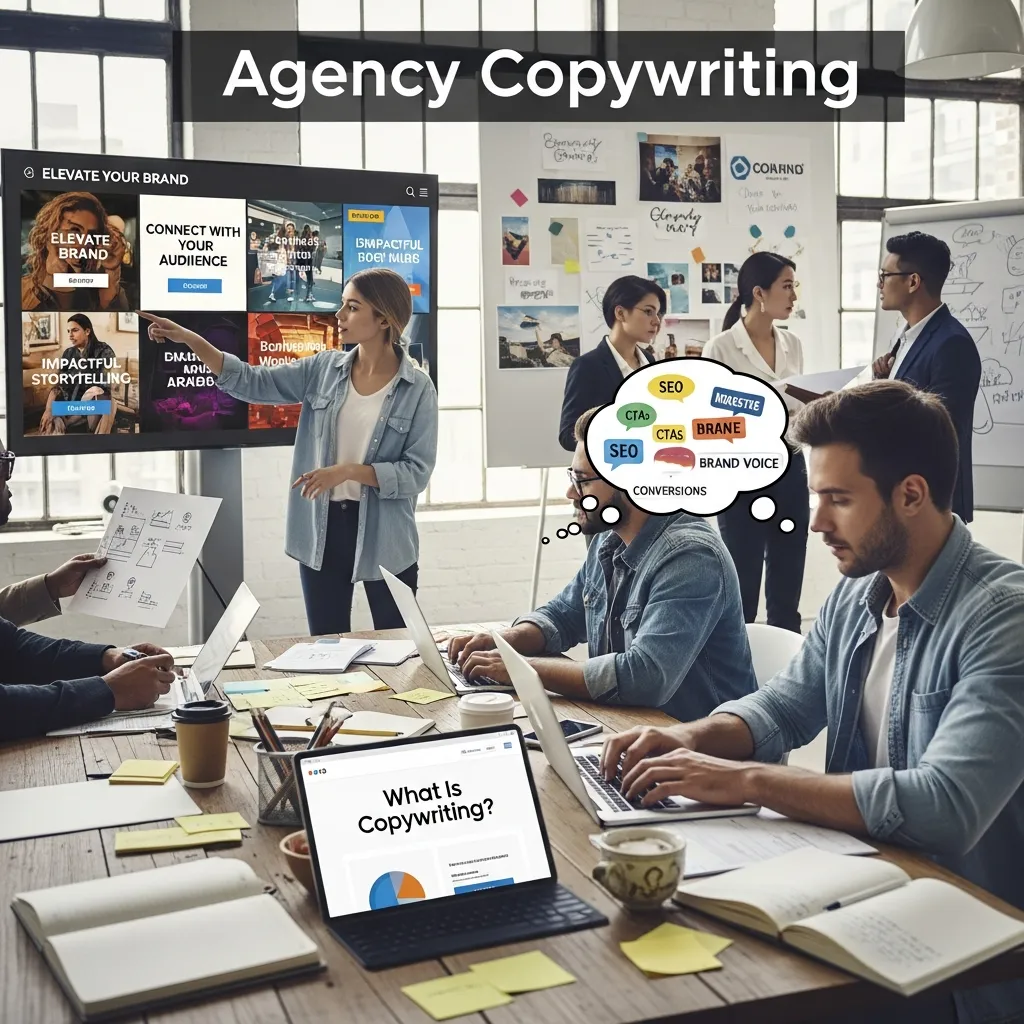
Agency copywriting refers to the creation of strategic written content by a team of professional writers working within or alongside a marketing agency. Unlike freelance or in-house writing, agency copywriting draws on a collaborative pool of specialists—strategists, SEO experts, editors, and brand consultants—to produce content that achieves specific business objectives.
The scope is broad. Agency copywriters produce everything from landing pages and email campaigns to social media posts and long-form editorial content. Each piece is crafted with a target audience in mind and aligned with the brand’s voice, commercial goals, and distribution channel.
Why does this matter? Because the digital marketplace is crowded. Businesses publish millions of blog posts, social media updates, and ad campaigns every day. Without strategic, well-executed copy, even the best products get lost in the noise. Agency copywriting cuts through that noise with precision—delivering the right message, to the right person, at the right time.
The Core of Agency Copywriting
How Do You Understand Your Audience in Copywriting?
Effective agency copywriting starts with a deep understanding of the audience. This means going beyond basic demographics—age, location, income bracket—and diving into psychographics: values, motivations, frustrations, and aspirations.
Most agencies build detailed buyer personas to guide this process. A persona is a semi-fictional representation of an ideal customer, grounded in real data gathered from interviews, surveys, and analytics. When copywriters know who they’re speaking to, every word becomes more purposeful. Vague, generic messaging gets replaced with language that resonates on a personal level.
What Makes Headlines and Subheadings Effective?
Your headline is the first—and sometimes only—impression your content makes. Research from the Nielsen Norman Group suggests that 80% of readers never make it past the headline. That statistic alone underscores why agencies invest significant time in headline testing and optimization.
Strong headlines are specific, benefit-driven, and create a sense of urgency or curiosity. Subheadings serve a complementary role: they guide readers through long-form content, signal what each section covers, and support SEO by incorporating relevant keywords naturally.
How Does Storytelling Enhance Agency Copywriting?
Humans are wired for stories. The best agency copywriters don’t just list features or recite statistics—they frame information within a narrative that makes the reader feel something. This could be as simple as leading a case study with a client’s struggle before revealing the solution, or opening an email campaign with a relatable scenario before presenting the offer.
Storytelling in business copywriting creates emotional connection, and emotional connection drives action.
What Persuasion Techniques Do Agency Copywriters Use?
Professional agency copywriters rely on proven persuasion frameworks to structure their content:
- AIDA (Attention, Interest, Desire, Action): A classic model that guides the reader from initial hook to final conversion.
- PAS (Problem, Agitate, Solution): Particularly effective for sales pages and email marketing, this framework identifies a pain point, intensifies it, then presents the solution.
- The Four Us: Headlines and subject lines are evaluated against whether they are Urgent, Unique, Useful, and Ultra-specific.
These frameworks aren’t rigid formulas—they’re flexible tools that experienced writers adapt based on the audience, channel, and objective.
Types of Agency Copywriting Services
Website Copywriting Services: Landing Pages, About Pages, and Service Pages
Web copywriting services form the backbone of most agency copywriting engagements. A well-crafted landing page can dramatically increase conversion rates. An About page builds credibility and humanizes the brand. Service pages communicate value clearly and help prospects self-qualify before reaching out.
Each page type demands a different approach. Landing pages are laser-focused on a single conversion goal. About pages balance personality with professionalism. Service pages must balance technical detail with accessibility—explaining what you do without losing readers in jargon.
Blog Content and Article Writing
Long-form blog content serves two primary purposes: educating the audience and improving organic search visibility. A well-researched, strategically structured blog post can rank for competitive keywords, attract inbound traffic, and establish a brand as a credible authority in its field.
Effective blog writing integrates keyword research, internal linking, and clear formatting—but never at the expense of genuine value for the reader.
Social Media Copy: How Do You Engage Your Audience?
Social media copy operates on tight constraints—limited characters, short attention spans, and high competition for visibility. Agencies producing social content must master the art of brevity: conveying a clear message, sparking engagement, and reinforcing brand voice in just a few lines.
Platform matters too. LinkedIn copy is more professional and insight-driven. Instagram captions lean into lifestyle and personality. X (formerly Twitter) rewards wit and brevity. An experienced agency tailors its approach to each channel rather than repurposing the same content across all platforms.
Email Marketing Copy: Nurturing Leads and Driving Conversions
Email remains one of the highest-ROI channels in digital marketing, with Litmus reporting an average return of $36 for every $1 spent (Litmus, 2023). Effective email copywriting requires compelling subject lines, personalized messaging, and strategically placed calls to action.
Agency copywriters approach email sequences with a clear understanding of where the reader sits in the customer journey—whether they’re a new subscriber being welcomed, a warm lead being nurtured, or a lapsed customer being re-engaged.
Advertising Copy: Print, Digital, and Video Scripts
Ad copy demands economy of language. Every word must earn its place. Whether it’s a 30-second video script, a Google Search ad, or a full-page print advertisement, advertising copy lives and dies by its ability to communicate a single, compelling idea quickly and memorably.
Great ad copy doesn’t shout—it speaks directly to a specific desire or fear, then offers a clear path forward.
SEO and AI Visibility in Agency Copywriting

How Do You Integrate Keyword Research into Agency Copywriting?
SEO-driven agency copywriting starts with thorough keyword research. Tools like Ahrefs, SEMrush, and Google’s Keyword Planner help identify the search terms a target audience is actively using. These keywords are then integrated naturally into headlines, subheadings, body copy, and metadata.
The goal is never to stuff keywords into content artificially—search engines have grown sophisticated enough to penalize this. Instead, skilled agency copywriters weave keywords into content contextually, ensuring the writing still flows naturally for human readers while signaling relevance to search algorithms.
For business copywriting, this often means targeting a mix of high-volume head terms and lower-competition long-tail keywords that attract more qualified traffic.
How Can Copywriting Be Optimized for AI Search Algorithms?
Generative Engine Optimization (GEO) is rapidly becoming a key consideration in agency copywriting. As AI-powered search tools like ChatGPT, Perplexity, and Google’s AI Overviews become more widely used, content must be structured in a way that AI systems can extract, summarize, and cite accurately.
Practically, this means:
- Using clear, self-contained statements that can stand alone out of context
- Structuring content with question-based headings that mirror how users query AI tools
- Including verifiable facts and named sources rather than vague general claims
- Adding answer-first summaries at the top of posts to help AI systems quickly identify the content’s value
What Is the Future of Copywriting with AI Tools?
AI writing tools—including ChatGPT, Claude, Jasper, and Writesonic—are changing how agencies produce content. These tools can accelerate research, generate first drafts, and support ideation at scale. However, they don’t replace the strategic judgment, brand expertise, and emotional intelligence that human agency copywriters bring to the table.
The agencies succeeding today are those using AI as a production accelerator, not a replacement for human craft. The result is faster output without sacrificing quality or strategic alignment.
Building a Successful Agency Copywriting Strategy
How Do You Define Brand Voice for Copywriting?
Brand voice is the consistent personality a brand expresses across all written communications. It encompasses tone (formal vs. conversational), vocabulary choices, sentence structure, and the emotional register of the writing. Agencies typically document brand voice in a style guide that writers reference for every piece of content.
Without a defined brand voice, content produced across different writers, channels, and campaigns will feel inconsistent—eroding trust and weakening brand recognition over time.
Why Do Content Calendars Matter in Agency Copywriting?
A content calendar is the operational backbone of any sustained agency copywriting strategy. It maps out what content will be published, on which channel, and when—ensuring consistent output and allowing for strategic alignment with product launches, seasonal trends, and marketing campaigns.
Editorial planning also prevents reactive, last-minute content creation, which tends to be lower quality and less strategically aligned.
How Do You Measure the Success of Agency Copywriting?
The metrics that matter depend on the content type and business objective. Common KPIs for agency copywriting include:
- Organic traffic: How many visitors are finding content through search engines?
- Conversion rate: What percentage of visitors are taking the desired action?
- Engagement metrics: Time on page, scroll depth, and bounce rate signal whether content is resonating.
- Email open and click-through rates: Indicators of subject line effectiveness and content relevance.
- Return on investment (ROI): Ultimately, how much revenue can be attributed to copywriting efforts?
How Does Collaboration Between Copywriters, Designers, and Developers Work?
Agency copywriting rarely exists in isolation. Effective content requires close collaboration between writers, designers, and web developers. Copy and design must work in tandem—headlines need space to breathe, CTAs must be visually prominent, and long-form content needs formatting support to remain scannable.
Agencies that build strong cross-functional workflows consistently produce higher-quality output than those where writing, design, and development operate in silos.
Challenges and Solutions in Agency Copywriting
Overcoming Writer’s Block on Client Projects
Writer’s block is a real and recurring challenge in any creative field. Agency copywriters combat it through structured pre-writing processes: audience research, competitive analysis, content briefs, and frameworks like AIDA or PAS. Having a clear strategic foundation before writing begins dramatically reduces the likelihood of stalling.
Managing Client Expectations in Copywriting Engagements
Misaligned expectations are among the most common sources of friction in agency copywriting relationships. The fix is proactive communication: detailed briefs, clear revision policies, realistic timelines, and regular check-ins throughout the project lifecycle. When clients understand the process, they’re better equipped to provide useful feedback.
How Do Agencies Stay Updated with Copywriting Industry Trends?
The copywriting landscape evolves constantly—driven by algorithm updates, platform changes, AI developments, and shifting consumer behavior. Agencies stay current through ongoing professional development: industry newsletters, conferences, case study analysis, and regular performance reviews of their own published content.
The Lasting Impact of Strong Agency Copywriting

Agency copywriting is one of the most durable investments a business can make in its marketing infrastructure. The right words, placed in the right context, continue working long after they’re published—attracting organic traffic, building brand authority, and converting readers into customers around the clock.
The businesses that treat copywriting as a strategic asset—not just a content production function—are the ones that build lasting competitive advantages. A clearly defined brand voice, an audience-first approach, and a commitment to continuous optimization create a compounding effect over time: every piece of content strengthens the next.
The path forward is clear. Audit your existing content. Identify gaps in your web copywriting services. Invest in a structured agency copywriting strategy. And measure everything—because what gets tracked gets improved.
Frequently Asked Questions
What is the difference between copywriting and content writing?
Copywriting is primarily focused on persuasion and driving a specific action—such as making a purchase, signing up, or clicking a link. Content writing prioritizes education, information, and audience engagement, with conversion as a secondary goal. In practice, strong agency copywriting blends both disciplines.
How can agency copywriting improve my business’s ROI?
Agency copywriting improves ROI by increasing organic traffic through SEO-optimized content, improving conversion rates on landing pages and email campaigns, and reducing customer acquisition costs by attracting higher-quality leads. According to Demand Metric, content marketing generates three times more leads than traditional outbound marketing at 62% less cost.
What are the essential skills for an agency copywriter?
Key skills include audience research, persuasive writing, SEO knowledge, adaptability across formats and industries, strong editing abilities, understanding of brand voice, and increasingly, familiarity with AI writing tools and GEO principles.
How long does it take to see results from good copywriting?
SEO-driven content typically takes three to six months to generate significant organic traffic growth. Paid ad copy and email campaigns can show results within days or weeks. The timeline depends on the content type, channel, competition level, and how consistently the strategy is executed.
How do you integrate SEO best practices into agency copywriting?
SEO integration involves conducting keyword research before writing, incorporating focus and supporting keywords naturally into headlines, subheadings, and body copy, optimizing meta titles and descriptions, using internal and external linking strategically, and formatting content for readability with clear heading hierarchies.
Can AI truly replace human agency copywriters?
No. AI writing tools can generate drafts, suggest structures, and accelerate production—but they lack the strategic judgment, brand expertise, cultural nuance, and emotional intelligence required for truly effective agency copywriting. The strongest agencies use AI to enhance human creativity, not replace it.
What is the typical process for a copywriting project?
A standard agency copywriting project follows these stages: client briefing, audience and competitor research, keyword research (for SEO-driven content), content outline approval, first draft, client review and revisions, final approval, and publication or handoff. Timelines and revision rounds vary by agency and project scope.
How important is understanding the target audience in copywriting?
Audience understanding is the single most important factor in effective agency copywriting. Copy that speaks directly to a reader’s specific pain points, desires, and language patterns consistently outperforms generic messaging. Agencies invest heavily in persona development and audience research for this reason.
What makes a good call to action (CTA)?
An effective CTA is specific, benefit-oriented, and creates a sense of urgency or clarity. “Download your free guide” outperforms “Click here.” “Start your free 14-day trial” outperforms “Sign up.” The best CTAs align closely with the reader’s current stage in the customer journey and reduce perceived friction.
How can I find the right agency for my copywriting needs?
Look for agencies with demonstrated experience in your industry, a clear process for audience research and briefing, a portfolio of measurable results, and transparent communication practices. Ask for case studies, request sample content, and assess whether the agency’s own website copy reflects the quality of business copywriting they promise to deliver.
What are some common mistakes to avoid in business copywriting?
The most frequent mistakes include writing for the brand instead of the audience, using jargon that alienates readers, neglecting SEO fundamentals, publishing without a clear CTA, ignoring mobile readability, and failing to test or iterate based on performance data.
How do web copywriting services differ across industries?
Web copywriting services are tailored to each industry’s audience expectations, regulatory considerations, and conversion goals. A legal firm requires authoritative, trust-building copy with careful attention to compliance. A consumer e-commerce brand needs punchy, benefit-driven language with strong CTAs. A SaaS company demands clarity around complex features and ROI-focused messaging. Effective agencies research each industry’s language norms before producing a single word.