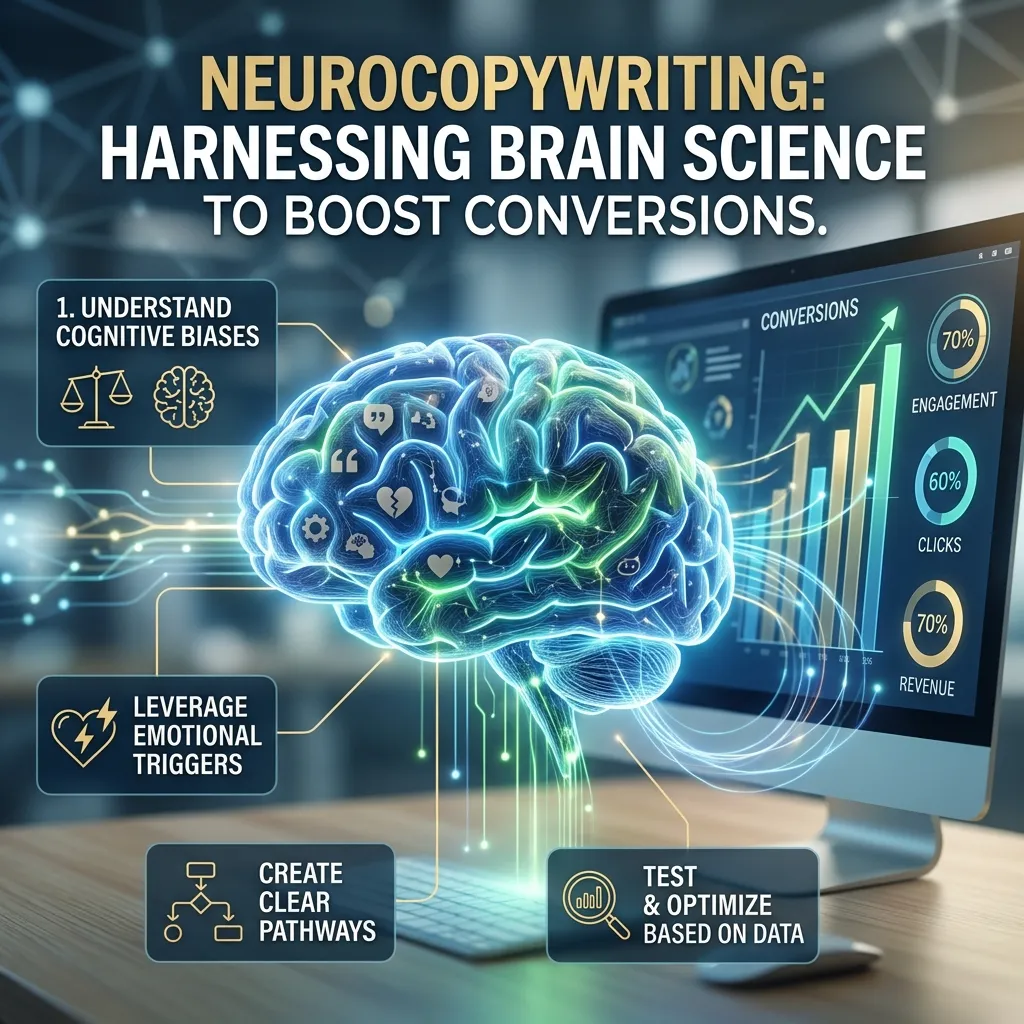
In today’s digital landscape, capturing a reader’s attention and guiding them toward action requires more than persuasive language; it demands an understanding of how the human brain processes information. This is where neurocopywriting comes into play. Neurocopywriting combines insights from neuroscience and cognitive psychology with proven copywriting techniques to form messages that resonate on a subconscious level. By aligning your content with the brain’s natural preferences for novelty, emotion, and clarity, you can enhance engagement, improve retention, and drive conversions effectively.
Currently, businesses face an overwhelming volume of content vying for every second of consumer attention. In this environment, subtle tweaks drawn from neural mechanisms can make the difference between a scrolled-past article and a clicked-through call to action. Today’s post will walk you through core principles, strategic techniques, and practical steps to implement neurocopywriting in your campaigns. Whether you’re drafting an email subject line or designing a landing page, understanding the interplay between attention, emotion, and decision-making will afford you an unparalleled edge.
Over the next sections, you’ll discover how to harness attention triggers, craft sensory-rich narratives, and leverage social proof to foster trust. We’ll also explore how to structure compelling calls to action and apply behavioral models for ongoing optimization. By the end of this article in 2026, you’ll be ready to infuse every headline, paragraph, and prompt with brain-friendly elements that speak directly to your audience’s neural wiring. Let’s embark on this journey toward copy that truly connects and converts.
The Fundamentals of Neurocopywriting and Consumer Attention
At the heart of neurocopywriting lies the principle that our brains are wired to conserve resources by filtering out repetitive or irrelevant information. This phenomenon is managed by the salience network—a neural pathway that prioritizes unexpected or novel stimuli. To break through this biological filter, your copy must contain elements that stand out instantly.
One of the most effective ways to capture attention is through contrast. Whether it’s pairing bold typography with white space or juxtaposing unexpected words, creating visual or verbal disparities jolts the reader’s neural circuits. For example, embedding a surprising statistic within an otherwise conventional headline will activate dopamine pathways, increasing the likelihood that a reader will continue scanning your content.
Another key driver of attention is novelty. Our brains respond positively to fresh concepts, as they may contain valuable information essential for survival. In practical terms, this means avoiding clichéd openings and opting instead for intriguing questions or statements. Asking “What if you could decode your customer’s hidden desires?” stimulates curiosity by promising new insights, thereby boosting click-through rates.
Finally, readability plays a crucial role in reducing cognitive load. Large blocks of text can deter even the most interested readers. Use short paragraphs, bullet points, and subheadings to guide eyes smoothly down the page. This structural clarity aligns with how the brain processes visual information, enabling faster comprehension and reducing mental fatigue. By combining contrast, novelty, and readability, neurocopywriting establishes a strong foundation for sustained engagement.
Emotional Engagement through Sensory-Rich Narratives

Cognitive Shortcuts and Social Proof in Persuasion
Humans rely on cognitive heuristics—mental shortcuts that simplify decision-making. Neurocopywriting leverages these shortcuts, guiding readers toward favorable choices without overwhelming them with details. One such heuristic is social proof: our inherent tendency to follow the actions of others when uncertain.
Incorporating testimonials, case studies, or usage statistics taps into the mirror neuron system, giving readers confidence that if their peers have succeeded, they can as well. For maximum effectiveness, choose testimonials that include specific data points or tangible results. A quote like “I boosted my signup rate by 63% within a month” feels more credible than a vague endorsement.
Authority cues also play a significant role. Citing reputable institutions or experts triggers trust and can reduce skepticism. For example, referencing a study from the National Institutes of Health (NIH) or Harvard University (Harvard University) lends weight to your claims. Even logos or badges of affiliations can subtly reassure readers about your credibility.
Another useful shortcut is scarcity. Highlighting limited-time offers or capped availability creates urgency, prompting quicker decisions. However, this must be genuine; falsely manufactured scarcity can backfire and damage long-term trust. When balanced correctly, these cognitive shortcuts help streamline the reader’s path from interest to action, making your copy both efficient and effective.
Structuring High-Impact Calls to Action

Understanding the Power of CTAs
A clear, compelling call to action (CTA) is the culmination of all preceding elements. According to the Fogg Behavior Model, behavior occurs when motivation, ability, and a prompt converge simultaneously. To align with this model, your CTA must:
- Sustain motivation through emotional and social proof
- Be simple and easy to complete
- Appear as a clear and unmistakable prompt
Using Powerful CTA Language
First, ensure your CTA language leverages power words such as “discover,” “unlock,” or “transform.” These emotionally charged terms tap into psychological triggers and encourage stronger engagement.
For example:
- “Unlock Your Free Consultation”
- “Discover Your Growth Potential”
- “Transform Your Marketing Strategy”
These phrases feel far more persuasive than generic options like “Get Started.”
Reducing Friction for Better Conversions
Second, reduce friction by simplifying the conversion process. Limit unnecessary form fields, provide autofill options, and clearly explain the next steps.
Each additional hurdle reduces user ability and increases the likelihood of abandonment. A smooth and intuitive experience keeps users moving toward action.
Enhancing CTA Visibility with Design
Design plays a critical role in CTA performance. Use elements such as:
- Color contrast
- Whitespace
- Directional arrows
- Progress indicators
Phrases like “Step 1 of 3” create reassurance and make the process feel achievable. Strategic CTA placement—above the fold, mid-content, and at the end—also helps capture different reader behaviors without appearing repetitive.
Creating Consistent Conversion Paths
By integrating motivational language, frictionless pathways, and visually clear prompts, your CTAs become significantly more effective. In today’s fast-paced digital environment, users appreciate clarity, simplicity, and direct communication.
Testing and Optimizing with Behavioral Models
Why Optimization Matters
Implementation is only the beginning. To improve your neurocopywriting strategy, you must continuously analyze performance and optimize based on user behavior.
Key metrics to monitor include:
- Click-through rate (CTR)
- Conversion rate
- Time on page
- Scroll depth
Tools like Google Analytics, heatmaps, and session recordings help identify where attention drops and which elements generate the strongest engagement.
A/B Testing for Better Results
A/B testing remains one of the most effective optimization methods. Test one variable at a time to clearly identify what drives performance improvements.
You can experiment with:
- Headline variations
- CTA wording
- Button colors
- Testimonial placement
- Sensory language
For instance, compare an emotionally driven introduction against a straightforward version to measure engagement differences.
Leveraging the Zeigarnik Effect
The Zeigarnik Effect suggests that people remember unfinished tasks more easily than completed ones. You can apply this principle by creating open loops or teasers within your content.
For example:
- End a section with a compelling question
- Tease an upcoming insight
- Hint at a valuable solution later in the article
These techniques encourage readers to continue scrolling and stay engaged longer.
Continuous Improvement Through Data

Even small adjustments—such as moving testimonials higher on a page or simplifying a CTA—can produce measurable improvements.
Neurocopywriting is an ongoing process of testing, learning, and refining. Over time, these incremental optimizations compound into stronger engagement, higher conversions, and more effective marketing performance.
Conclusion
In today’s competitive digital marketplace, mastering neurocopywriting gives your messaging a strategic advantage. By understanding attention mechanisms, weaving sensory-rich narratives, and leveraging social proof, you create content that aligns with how the brain naturally processes information. Structuring persuasive calls to action using models like BJ Fogg’s ensures that motivation, ability, and prompts converge for maximum impact. Finally, ongoing testing and optimization allow you to fine-tune every element, boosting engagement and conversions consistently.
Implement these brain-based strategies in your next campaign and witness firsthand how subtle shifts in language, structure, and design can transform passive readers into active customers. Neurocopywriting is more than a set of techniques—it’s a mindset that prioritizes empathy, clarity, and scientific insight in every word you write.